Vacuum Anxiety in Pets: Calm Training Routine
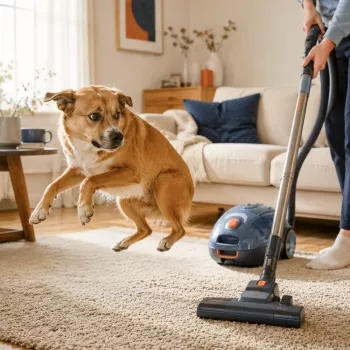
Helping Pets Handle Vacuum Stress: A Calm, Step-by-Step Routine
Vacuum cleaners combine loud noise, sudden movement, and unfamiliar airflow—common triggers for pets. A predictable routine, gradual exposure, and a safe “off switch” space can reduce fear behaviors and help cleaning days run smoothly for both animals and humans.
Why vacuums feel overwhelming to pets
Many pets aren’t being “dramatic”—they’re reacting to a bundle of sensations that can feel intense or even threatening.
- Noise sensitivity: High volume plus shifting pitch can startle sensitive ears and keep the body on alert.
- Movement and vibration: A rolling machine that approaches, retreats, and pivots can resemble a threat pattern.
- Airflow and debris: Gusts, dust, and sudden scent changes can be confusing or physically irritating.
- Past experiences: One scary incident (a tail caught, a cornered moment) can create long-term avoidance without retraining.
Signs a pet is stressed (and when to pause training)
Progress happens when your pet stays under threshold—aware, but still able to eat, think, and recover quickly.
- Mild stress: Lip licking, yawning, tucked tail, ears back, leaving the room.
- Moderate stress: Trembling, panting (not heat-related), hiding, pacing, refusal of treats.
- High stress: Growling, snapping, attempting to escape, urinating/defecating, prolonged shutdown.
Safety note: If high-stress signs show up, stop the session, increase distance, and restart later at an easier step. For guidance on behavior support resources, the American Veterinary Medical Association (AVMA) and the American College of Veterinary Behaviorists (ACVB) are helpful starting points.
Set up a “safe zone” before turning anything on
A safe zone is your pet’s clear signal that they can opt out. Think of it as a calm “off switch” that prevents panic from rehearsing.
- Choose a quiet space: A back bedroom, office, or crate area with a comfortable bed, water, and a chew or food puzzle.
- Use consistent cues: Say the same phrase (like “quiet room”), guide them in, then give a small treat so the cue predicts comfort.
- Add sound buffering: Close doors, run a fan/white noise, or play low, steady music to soften the vacuum’s peaks.
- Prevent chase behaviors: Use a baby gate or closed door so the vacuum never “pursues” them down a hallway.
A gradual plan that teaches the vacuum is not a threat
Desensitization and counterconditioning work best when steps are tiny and success is easy. The goal isn’t to “get through it,” but to build a new association: vacuum = good things happen, and I’m safe.
- Start with the vacuum off: Place it in view at a distance. Reward calm looking, sniffing, or neutral behavior.
- Break it into micro-steps: Move it slightly, touch the handle, plug it in, then turn it on very briefly.
- Pair exposure with high-value rewards: Use tiny pieces of chicken/cheese (if diet allows) or a favorite toy for quick, upbeat reinforcement.
- Keep sessions short: Aim for 1–3 minutes and stop while your pet is still comfortable.
- Increase difficulty slowly: Decrease distance first, then increase duration, then add gentle movement.
Sample desensitization schedule (adjust pace to the pet)
| Stage | What happens | Goal behavior | When to move on |
|---|---|---|---|
| 1 | Vacuum sits in room (off) | Pet can eat treats/play at a distance | No avoidance for 2–3 sessions |
| 2 | Human approaches vacuum; touches handle (off) | Pet stays relaxed; takes treats | Body loosens; no retreating |
| 3 | Vacuum is moved a few inches (off) | Pet remains calm; can disengage and re-engage | Pet chooses to stay in area |
| 4 | Vacuum turns on for 1–2 seconds at a distance | Pet accepts treats; minimal startle recovery | Quick recovery within seconds |
| 5 | Vacuum runs 10–20 seconds; minimal movement | Pet stays under threshold; can focus on rewards | Stable calm across multiple sessions |
| 6 | Normal vacuuming pattern; pet in safe zone or at distance | Pet relaxes in safe zone or ignores | Vacuuming can occur without distress signals |
What to do during vacuuming (real-life routines that work)
Training is ideal, but cleaning still has to happen. Use management and predictability so vacuum day doesn’t turn into an escalating event.
- Use management first: Place your pet in the safe zone with a long-lasting chew or stuffed food toy before you start.
- Create predictability: Vacuum at similar times, follow the same order of rooms, and announce the routine with a consistent cue.
- Limit exposure: Vacuum one section, pause, then continue—especially early in the process.
- Reduce intensity: Use the lowest effective power setting, shorter bursts, and attachments that rattle less.
- Reward calm afterward: A treat scatter, quick game, or short walk can prevent “vacuum predicts bad time” associations.
If household stress runs high during training weeks, a short daily reset for the humans can make consistency easier to maintain. The 5-Minute Reset for Exhausted Parents (3 in 1) is a quick option for calming breathing and focus before starting a session.
Special considerations for dogs, cats, and small pets
When extra support helps
For additional context on fearful behavior patterns, the RSPCA’s pet welfare guidance can be a useful reference.
Product option for structured guidance and routines
Some households do best with a consistent, measurable checklist that everyone follows the same way. Helping Pets Handle Vacuum Stress is designed as a ready-to-follow framework that emphasizes gradual exposure, reward timing, and practical management (safe zones, predictable routines, and avoiding forced interactions).
For pet parents who like tracking progress and sticking to a calm routine, Mindful Clarity: Journal & Prompts can help document what stage you’re on, what rewards worked best, and which setups kept your pet most relaxed.
FAQ
What’s the easiest pet to handle?
“Easiest” depends on your lifestyle, space, and time. In general, pets with simpler daily exercise and training needs may feel easier, but individual temperament matters most—choose a species and personality that matches your household routine and stress tolerance.









Leave a comment